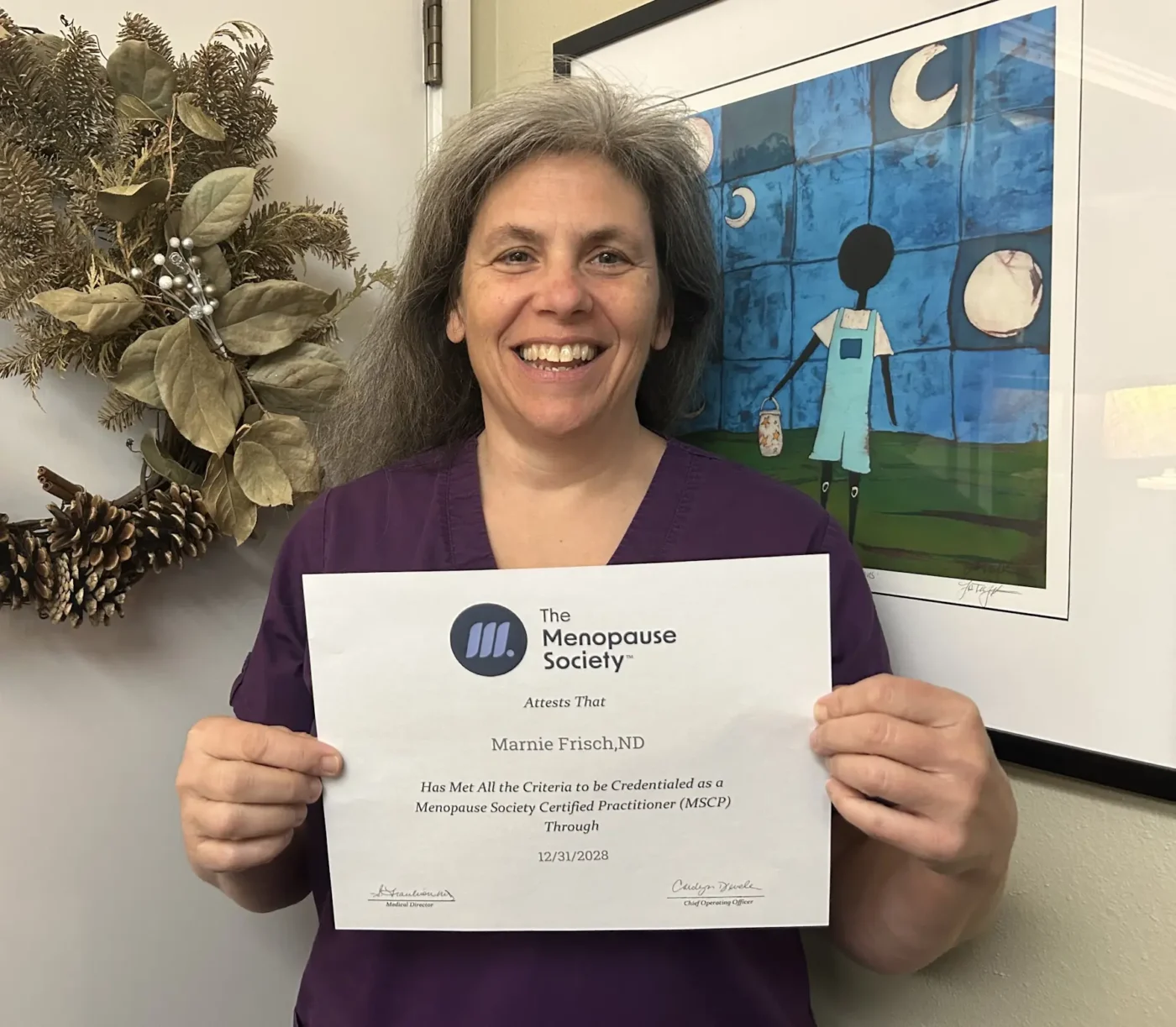
Last month, I attended the National Menopause Society Annual Conference in Florida. A week after returning to Olympia, I sat for, and passed, the Menopause Certified Practitioner examination. I am now officially a Certified Menopause Society Practitioner.
In a meaningful and somewhat poetic turn of events, both my sister (Dr. Hope Frisch, an OB/GYN in Minnesota) and I achieved this milestone in the same week. It made my father (Dr. Melvin Frisch, MN), a retired OB/GYN, especially proud to see his two daughters following in his footsteps. He was truly ahead of his time — in fact, he published a book in 1993 titled Stay Cool Through Menopause. His passion for women’s health has undoubtedly influenced my own path.
I am very much looking forward to integrating more of what I learned into my clinical practice.
Reflections and Lessons of the National Menopause Society Annual Conference
The National Menopause Society’s annual conference is a multi-day, allopathic medical conference, with most speakers holding MD, PhD, or dual credentials. The program includes full days of lectures, plenary sessions on emerging research, and presentations from pharmaceutical companies (these sessions do not qualify for continuing education credit). At five days long, this conference differed significantly from other conventional medical events I’ve attended through Seattle Children’s Hospital, the University of Washington, and Swedish Hospital, which typically last a half or full day.
In addition to allopathic conferences, I routinely attend naturopathic, herbal, and integrative medicine conferences. As a licensed primary care naturopathic physician in Washington State, maintaining balance between these disciplines is essential to both my growth as a clinician and to the care I provide my patients.
One impactful observation — particularly after 18 years of clinical practice — was a recurring theme of skepticism, and in some cases open disdain, for any treatment not approved by the FDA. Unsurprisingly, there was no discussion of herbal medicine or homeopathy. A small number of presentations referenced double-blind, placebo-controlled studies examining supplements, with minimal differences observed — though many of these studies were limited in size, scope, and frequency. It is also important to note that several speakers disclosed associations with the pharmaceutical industry; these disclosures were transparently presented at the beginning of each lecture.
While I found the scientific rigor valuable, I also found this omission problematic, given that an estimated 55–67% of women use some form of complementary or alternative medicine. Rather than dismissing these therapies outright, it would better serve clinicians and patients alike to understand why so many individuals turn to them and to distinguish between poorly manufactured products and those with quality sourcing, historical use, and measurable benefit. Many herbal, homeopathic, and nutritional treatments have been used for centuries, if not longer.
I was grateful to have 18 years of naturopathic experience grounding me while attending this conference. It allowed me to remain rooted in holistic, individualized care while staying open to the strengths of the allopathic approach. This balance, I believe, will only strengthen my ability to serve my patients.
I am not prepared to discount decades — even centuries — of clinical experience simply because a treatment lacks FDA approval. At the same time, I deeply value scientific inquiry and remain committed to understanding what we know, what we do not yet know, and how we can continue to ask better questions. Evidence-based medicine is essential, and the quality of evidence truly matters. Findings from small or poorly designed studies should guide further research rather than be accepted as definitive fact.
This is especially important in the world of menopause care, where so much information online is unsupported, biased, or financially motivated. As a physician whose practice is rooted in face-to-face care, time, communication, and trust, my role is to translate the available clinical evidence, apply professional expertise, and most importantly, listen to my patients’ goals, values, and comfort with both known and unknown risks. That is how we empower people to make informed, individualized decisions — rather than relying on internet trends or one-size-fits-all solutions.
This conference was not only educational but also deeply clarifying. It reaffirmed my belief that the best medicine lies at the intersection of science, clinical experience, tradition, and patient-centered care.
Attending the National Menopause Society Annual Conference with over 1,200 practitioners in one space reinforced both a hard truth and a hopeful one: women’s health is still significantly underserved — but the momentum for change is growing.
This stage of life is not just about managing symptoms of hormone decline. It is a pivotal window for prevention, education, and whole-body healing. The sessions I attended clarified several important clinical and personal insights that will directly shape how I care for my patients moving forward.
Below are some of the most impactful lessons — for both clinicians and women navigating perimenopause and menopause.
Key Takeaways From the Menopause Conference — For Clinicians & Patients
1. Women’s health is chronically underserved
While that fact is frustrating, sitting in a room with over 1,600 practitioners dedicated to the advancement of women’s health was deeply encouraging. It was a shared feeling — voiced by many of the speakers — that this field is overdue for greater attention, funding, research, and respect.
2. Perimenopause and menopause are a window of opportunity— not just a symptom phase
The perimenopausal and menopausal years can last a long time. Rather than focusing solely on declining hormone levels, this stage of life is a critical time to address:
- Mental health
- Cardiovascular health
- Bone health
- Metabolic health
- Sexual health
- Sleep and stress regulation
This is truly one of the most impactful periods for preventive and long-term health planning.
3. Menopause care deserves its own appointment
Menopause concerns should not be squeezed into an annual wellness visit. A wellness visit is the right place to review risk factors and complete necessary screenings. However, hormone therapy and symptom discussions require time, context, nuance, and shared decision-making. These conversations deserve a dedicated visit.
4. Cardiovascular disease — not breast cancer — is the #1 killer of women
Cardiovascular disease remains the leading cause of death in women and is one of the most important risk factors to consider when prescribing oral hormone replacement therapy — even more so than breast cancer risk.
Large, reliable studies on stroke risk and topical hormones do not yet exist (most data is based on oral therapy and most hypothesize that it is a safer option) which makes addressing cardiovascular health even more essential during this stage of life.
Key foundational targets include:
- Blood pressure under 130/80
- Optimizing cholesterol and metabolic markers
- Prioritizing lifestyle changes (diet, movement, sleep, stress reduction)
- Screening for history of preeclampsia, gestational diabetes, or pregnancy-induced HTN
This phase of life is a prime opportunity to prevent future cardiovascular disease.
5. Oral contraceptives can be appropriate hormone therapy in perimenopause
In perimenopause, ovaries produce estrogen and progesterone in a highly unpredictable, fluctuating pattern. For many individuals, this hormonal “roller coaster” contributes to significant symptoms.
While naturopathic and lifestyle approaches are often very effective in early perimenopause, when hormone therapy is needed, oral contraceptive pills (OCPs) may actually offer better stability than traditional lower-dose hormone replacement. The higher and more consistent hormone levels in OCPs can override erratic ovarian production and restore a more steady hormonal environment.
By contrast, standard menopausal doses of “bioidentical” creams or patches may sometimes add to irregularity during perimenopause rather than stabilize it.
6. The term “bioidentical” is largely a marketing term
“Bioidentical” was popularized by compounding pharmacies as a marketing term. In reality, there are multiple FDA-approved, insurance-covered hormones that are bioidentical, meaning they are structurally identical to what the body naturally produces. There is a place for compounding in menopausal care, but marketing terms should not replace individualized, evidence-based care.
7. Ovaries are more than reproductive organs
Ovaries play roles beyond reproduction — they are connected to metabolic and immune function. Even after menopause, the ovaries are still doing something — we just don’t fully understand what yet.
This is part of the larger problem in women’s health: female bodies have historically been studied primarily in the context of reproduction rather than as complex, integrated biological systems.There is some indication that removal of ovaries (oophorectomy) may alter long-term health risks — but the data is incomplete. This is not meant to create shame if you have had your ovaries removed. Rather, it is to empower you — your body and your experiences matter, and any intuitions or concerns you may have about losing your ovaries deserve attention, discussion, and individualized care.
8. “Life extension” still starts with the basics
Despite the popularity of supplements, peptides, and “anti-aging” protocols, the foundation of longevity remains:
- Nutrition
- Movement
- Strength training
- Sleep consistency
- Stress management
- Purpose and connection
There is still no substitute for these core lifestyle practices when it comes to reducing inflammation, improving metabolic health, and slowing systemic aging.
9. Sleep is non-negotiable
A stable sleep schedule is one of the most powerful tools for whole-body health. Research presented linked good sleep with:
- Reduced total and subcutaneous fat
- Lower oxidative stress
- Lower inflammation
- Improved metabolic function
10. Weight gain in midlife is real — and researched
Weight gain during perimenopause and menopause is biologically driven and well-documented. What worked before often no longer works. Studies unfortunately show that women often must significantly reduce caloric intake (sometimes as low as ~1500 calories/day) to see changes — which can feel unfair and discouraging.
This is why realistic expectations, compassion, strength training, and metabolic support are so essential.
11. Bone loss begins earlier than most women realize
Bone density loss starts up to 2 years before the final menstrual period and continues for 2–3 years afterward. Medications such as SSRIs can further decrease bone density, highlighting the importance of early monitoring.
12. Sexual health is about more than hormones
The top two predictors of sexual well-being in women are:
- Overall sense of well-being
- Quality of the relationship with one’s partner
Factors such as arousal, lubrication, and hormone levels are only part of a much bigger picture.
Interestingly, testosterone and DHEA levels have not been shown to consistently correlate with sexual desire or dysfunction, despite popular belief.
In summary, the conference reinforced that menopause care requires a balance of science, clinical experience, and patient-centered communication. Evidence-informed treatments, combined with attention to lifestyle, mental health, and whole-body wellness, allow women to thrive during this stage of life.
— Marnie Frisch, ND, MSCP
Whole Health Naturopathy, Olympia, WA